Friday, February 22, 2013

Confessions of a Minimalist — Storage

The bus in winter
A few words about storage: Know where things are. Ziploc bags.

Having stuff can be burdensome. But everyone has some stuff. In the confines of a small space even a very modest amount of stuff can be a problem. 

I am not going to suggest I know how to store your things better than you do. Or what your storage space looks like. I'm only going to suggest a golden rule or two of storage. Know where everything is. Use Ziploc bags.

Knowing where everything is lets you find what you need quickly. It keeps you from making a mess looking for it.

The other golden rule is use plastic air-tight sealable bags. Everything from food to small electronics, to folded clothes and cosmetics, can go inside. They nest, small ones inside big ones. They tuck, they squeeze and go almost anyplace you want. You can write on them. They keep things clean. They do not take up more room than what they contain.

Unlike other containers they shrink as what is inside gets used.

Organize what you use everyday so it is close at hand. What you seldom use can be tucked away. For extra storage, a suitcase. 

An organized home is not only neat and clean and easier to live in. It makes you feel good about  yourself and keeps clutter from cluttering up your life.

A few tips: Shoes take up a lot of room. Minimize. So do bulky coats. Consider layering. Store like things together. I store cooking utensils inside a Coleman stove. They are there when I need them, out of the way when I don't. Always clean and straighten right away. Carry a rope or clothes line. Air things like linen and sleeping bags. Consider rooftop storage when traveling. Use folding chairs. When at a campsite think of the outdoors as your home. Set up camp accordingly. Have a system for laundry. Either washing a few things daily or a trip to a laundromat weekly. Practice cleanliness around your campsite, for your sake and the sake of others. Recycle. Share. Love. You want you life to work for you. Not the other way around.

Tuesday, February 19, 2013

Confessions of a Minimalist — Stuff

One thing years of living in a bus taught me:  You don't need much to be happy — food, shelter, love and companionship is about it. Anything else isn't gravy. It usually just gets in the way.

Now that I am not living in a bus, and taking time to write about it, I'm finding how easy it is to slip back into old ways.

Take CD's and DVD's, for example, Or books, or jeans and T-shirts. Or shoes. Another here, another  there. Soon clutter.

Living in a bus imposes strict limits on almost everything. My rule of thumb has been if I get something new, like a new book or CD, I get rid of an old to make room.

It's easy. Just give it away, or leave it to be found. Someone will want it.

This rule  not only keeps clutter from accumulating. It upgrades what you do have by forcing you to keep only what you really love and need.

Another rule is: If you haven't used it, worn it, eaten it or cooked with it in six months get rid of it. Obviously this does not apply to spare parts. It applies to almost everything else.

I could go on but I think the point is made. Having only what you need and nothing more simplifies your life.

NEXT:  Storage.

Wednesday, February 13, 2013

Differing Visions of Life in America

Like millions of Americans, I heard the president address the nation in his State of the Union address to Congress last night. I was impressed. He seemed relaxed and at the top of his rhetorical game.  

Yet the speech also troubled me.

President Barack Obama addresses the nation during the 2013 State of the Union in Washington D.C.
President Obama
If I heard him correctly he called for preschool  for all children beginning at age four.

He called for high school education more closely tied to job placement, more akin to an associate degree from a community college.

"To grow our middle class," the president said, "our citizens must have access to the education and training that today's jobs require."

He also made a pitch for an increase in the minimum wage, to $9 an hour, a  boost for the working poor.

It was about jobs and work — tailoring people to fit the world of work rather than tailoring the world of work  to fit people.

Those at the top prosper; those below perspire.

Wandering Wolf

If Mr. Obama was offering a vision of  utopia based on rewards, benefits and confinements of corporate America,  Wakatel Utiw—Wandering Wolf—a Mayan elder who has been walking the Americas, see things a little differently. 

Five hundred years of  rule by occupiers, colonialists and corporate interests has not created paradise in the Americas or the world, he says. It is a system based on greed. Its legacies are division, distrust, poverty and war.

Wandering Wolf 
Don Alejandro Cirilo Perez Olax, Wandering Wolf, is at the heart of the movie, Shift of the Ages, exploring the meaning of the Mayan and other indigenous peoples' visions for a better way of live. For more than seven years he has traversed the Americas from Guatemala to Peru and Bolivia, meeting with elders and speaking speaking of a coming change foreseen by his people as long count  calendar comes to a close and a new epoch begins. 

Although the time is now for a new era, he says, mankind must end its divisions and we must work together to make it happen—to end the fouling of our air and water, to end poverty, to end war and greed. 

“The new Sun will come, but if we don’t change our destructive and disharmonious ways, many may not see it. We are not powerless over something happening to us," he says. "We are happening to the Earth and to each other.”

He points to 500 years of occupation, colonial rule and corporate oppression. The lessons of the old order are manifest in a world that has turned its back on the human spirit and preached a world of material plenty and spiritual poverty.

His words contrasted with the focus of the president's address stirred something in me.

Why should it be that in a world of plenty there is so much want?  Why should we begin preparing the young for a lifetime of work at the tender age of four? 

For what reason?  To get ahead?  Who profits?  Who loses?

A Theft of Tender Years


One of  nature's preschool instructors.
Taking four-year-olds, sparkling and spiritual and at an  age when imagination should be free to explore and to play, and putting them on the treadmill that feeds the maw of the corporate machine seems a crime against them and against all humanity.

Using education not to enlarge the spirit and expand the mind but to hone workplace skills seems not so much an exercise in developing  human potential as it does  in crushing it.

The rewards are the material gee-gaws and gadgetry that fill our empty days and overflow our landfills.

One thing that nights looking at stars and mornings watching a sun rise over mountains has taught me is that the stars and the moons and the mountains and the sunrise belong to all of us.  And so too the Earth.  And that there is no more beautiful sight than a free human cast in his or her own mold and not in the mold of others or the machine.

We should be careful what we ask when we seek to grow our economy, and wary of the price we may pay and the fuel we are putting into the fire, 

The four-year-old sitting by the campfire beside her mother, hearing the conversations of coyotes in the hills, the rustle of wind in the grass, the screeches of owls and chirrups of insects and frogs,  dreaming of life unfolding before her in her vivid imagination, will not be so happy in an air-conditioned preschool where she may learn keyboard skills but not know the scent of a pine forest.

Even if it does one day lead to a job.

Saturday, December 29, 2012

What Fiscal Cliff ?

Reading the news you would think we were all about to tumble over some steep precipice down into a ravine never to be seen or heard from again — the dreaded Fiscal Cliff. Well I just got gas, a cup of pretty good coffee for 89¢, looked out the window at the road ahead and it looks pretty smooth and flat.

There's a different perspective when you are driving a bus and living in a smaller world. Now if you raise the rates of camp sites, double the price of rice and beans, or if there are three straight days of rain I might complain.

But let's face it, folks, a few percentage points increase in SSI and taxes is not a catastrophe. Suck it up, America! You've been there before. Remember the 1990s ?  Not so bad !

As you start to walk out on the way, the way appears. -- Rumi.
So, what are folks so upset about? The image of a cliff is telling. What we as a nation seemed to be obsessed by are end-of-the-world, doomsday scenarios. The Mayan calendar thing. Global warming. Economic collapse. Social upheaval.

Maybe with good reason.

The complex world that the majority of us live in seems increasingly scary and morphing beyond our ability to control. Will I have a job tomorrow? Will the cost of living double? Will a  medical disaster strike?

Life was not always so complicated nor did we see ourselves as part of a large machine that seems to be becoming  increasingly unstable.

I close the door, turn the key, music kicks on floating above the sounds of the engine and the tires on the road.

Up ahead the sky is blue and flecked with December clouds and the mountains have been where they have always been.

Fiscal cliff? Not that I see, or in the rear view mirror either. In a simpler world you don't go over a cliff.


Wednesday, December 26, 2012

Book Review — The Ascent of Humanity by Charles Eisenstein

I have just come from reading on line The Ascent of Humanity by Charles Eisenstein. The online version I read was completed in 2006, therefore before the fiscal crisis of 2007 and much of what was to follow. It will be interesting to see what changes, if any, Eisenstein will have made in the final published version due out in February, available from Amazon.

The book is big both in scope and size — 600 pages. It is uneven but perhaps it could not have been otherwise given the vast landscape the author attempts to cover, and the destination he has in his sights — namely a new and enlightened world and humanity, but only after the old order collapses.

Charles Eisenstein
We have been living, says Eisenstein, since the dawn of agriculture in a linear world of cause and effect; of separation of from ourselves, each other and nature; of yours and mine; and marching to the drumbeat of a technological view of the world. Much has been achieved, but at great cost and ultimate peril to the planet and to ourselves.

Lost, he argues, is the instinctive recognition that all is sacred. That life is a holy web. And that we are, in our finest moments, all connected — not pawns in a dog-eat-dog capitalist/Darwinian jungle struggling for survival.

How do we get out of the mess we are in and onto higher ground?

Eisenstein gives no guarantees but argues it will happen. The foundations on which the industrial/ technological worlds have been built–material, economic, social and political–are unsustainable and failing. From the ashes of the old will arise the new. This is a big leap, an act of courage as much as an act of faith.

He points to small but important green shoots, of ecology, sustainable agriculture, renewable energy, spiritual searching, not as answers themselves to our plight but as pointers to what my lie ahead and grow — a new world of beauty and plenty when we cease its destruction and share in its bounty.

There is defiant optimism afoot here. Rewarding insights into many of our foibles. And some fresh thinking.

"The process (of our confusion and separation from the world) started eons ago with the development of symbolic culture, which mediated direct perception of reality with an abstract map of reality. Since then," says the author, "the fall from wholeness has accelerated."

In other words, says Eisenstein, when we put a label on a tree and call it a tree we no longer see it as a unique and sacred thing. We have defined it, labeled it, and now can clear cut a forest without remorse.

Violence is at the heart of  a world we try to control. "From the weeding of a strawberry bed to the coercion of a child to the elimination of enemies in the name of national security, the cultivation and control of the world inherently requires violence," he writes.

We need not control the world or ourselves. We need to see it whole again and ourselves not separate from it or each other.

It is a book that when you put it down you wish the author were there so that you might ask: "Well, Charles, all well and good, but how do we bring 7 billion souls and thousands of years of history around to a new way of seeing things?"


Tuesday, November 27, 2012

New Leg of the Journey

I no longer am living full-time in my bus. That does not mean the journey is over.

One of the benefits of minimalist living is that it strips away the value that we too often place on material goods and possessions. Often we do not even understand why we are so caught up in owning things that in end end up owning us. For anyone who has not seen it I recommend watching PBS's Scott Simon's Affluenza.

Colorado Monument 
I spent two weeks at Colorado Monument outside Grand Junction, coming down from the mountain only once for groceries and never tired of the experience – of waking up to a different dawn each day and being overwhelmed by the majesty I saw all around.

Nor did I tire of the other campers who came there.

One was a couple from Canada who brought with them a nephew and a powerful telescope and software that helped them find and zero in on planets and stars.

Another was a man fighting lung disease and breathing the clear air to get better. And he did. In just a few weeks' stay he was able to take long walks.

A third was a couple from Toronto, also in a Volkswagen, who came there "to find ourselves."  They were lost, they said, in their marriage and in the world until one day they realized they could wake up "without care or worry." And so they hit the road.

And the hodge-podge gang from Brooklyn – five guys who pooled their resources and bought a beat-up RV determined to make it to San Francisco and drink beer all the way. We laughed until it got dark at night and the stars came out.


While I was travelling many asked what I was doing to fill my days. Nothing, I replied. The days fill themselves. It is remarkable how little there is that needs to be done once you let go of the internal need for doing, as if your productivity somehow mattered to the world. It doesn't.

What you get as a life-long gift, just as happened with the couple from Toronto, is your sanity back.

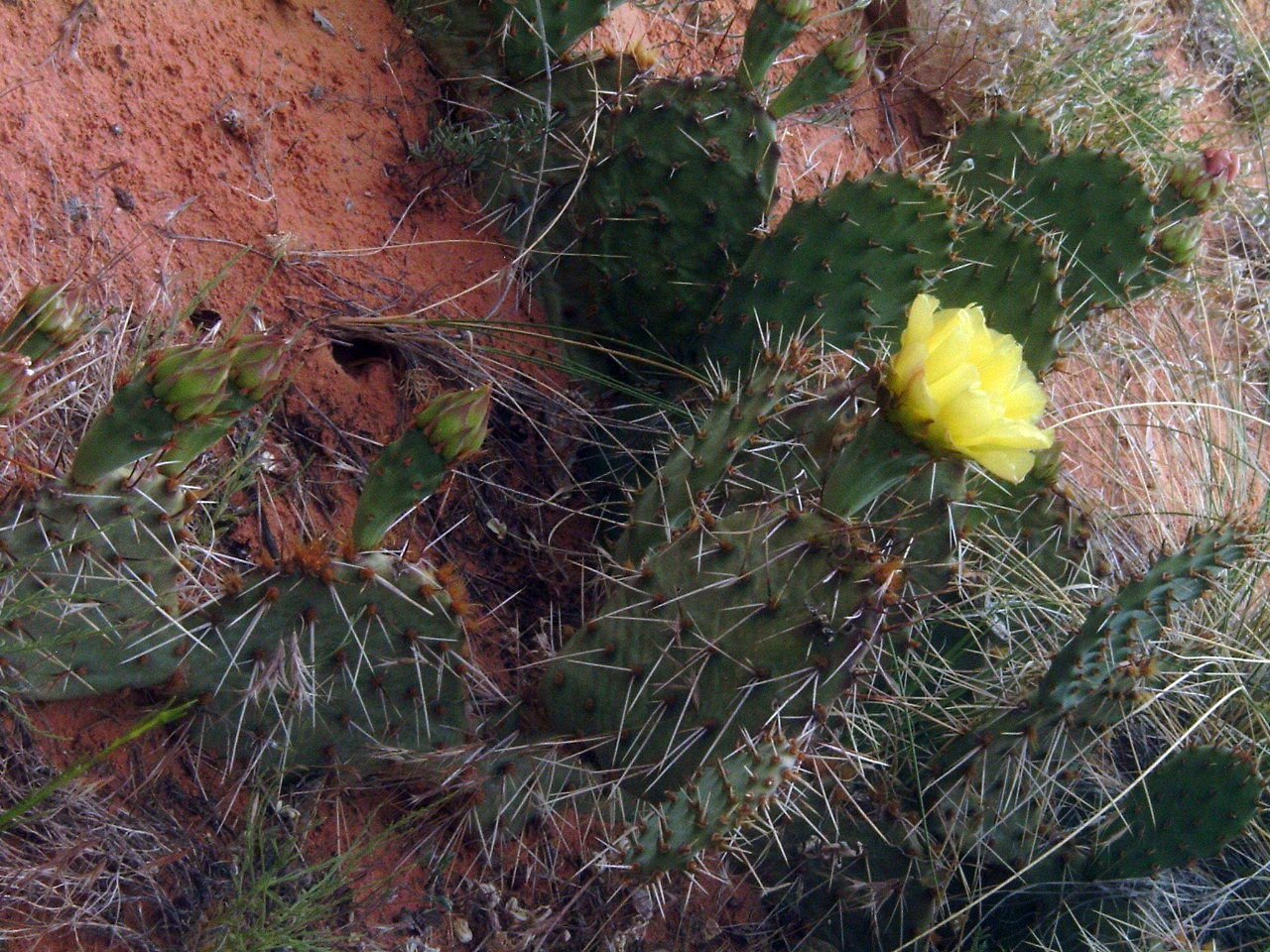
A desert cactus flowers.
Viewed from the grandeur of rugged peaks where artists come to paint, the world looks a lot bigger and we experience ourselves a lot smaller.

You can spend an hour watching an ant or a flower or a bee, and no time is lost at all, and what is gained is greater love of life. And maybe a little more understanding too – though not in a way that can be put into words.

A park ranger told me there that there is no shortage of water even in the semi-desert. "We get the right amount of water for everything that lives here," she said. For the junipers and the piñon pines, and the desert bluebirds that feed of the juniper berries, and the bees that visit the flowers, there is enough. And for scurrying mice and the hawks overhead. It's there.

It struck me that there was a lot of wisdom in that observation, and it had more to it than just an explanation of thriving desert life.

The riches of this planet whether sparse or lush are what they are. There is enough for everything and everyone that lives on this planet if we understand and ask only what we really need.

Colorado mountains viewed in westering sun from Monument.
And maybe that was what was so inviting in the song sung to me by the breeze up there are night:  that you have enough when you have enough, and you don't need more. Just a place to lay your head and sing your own song until the sun comes up again tomorrow as it always will.

Monday, November 19, 2012

Chimayó — Father Roca, Short Legs and a Long Life

It has been called the Lourdes of America. Since 1810, when the first chapel was built on the site, stories abound of miraculous cures.

Today, thousands of photographs, a hundred or more canes and crutches and wheel chairs left behind and no longer needed attest to cures said to have taken place at El Santuario del Chimayó 28 miles North of Santa Fe.


El Santuario del Chimayó
The present chapel was built in 1816. The original six years earlier.

Stories of how the first chapel was built, and  the second was brought back from oblivion, are stories of little miracles in their own right.

The story of the original chapel dates to 1810 when Bernardo Abeyta saw a strange light coming from a hill above the Santa Cruz river. When he went to the site and dug he uncovered a buried crucifix.

Three times the crucifix was taken to the local village. And three times it disappeared only to be found again at the original site.

Señor Abeyta got the message. A chapel should be built there. And it was. Almost immediately word spread of the healing power of the little church, and  in 1813 Abeyta asked permission to build a bigger chapel. The chapel that now stands was completed in 1816.


For more than a hundred years the chapel remained in the private hands of the Abeyta family. By pilgrims continued to come and make offerings. But by 1929 the chapel had fallen into disrepair. To preserve the little chapel  it was purchased by preservationists and given to the  Archdiocese of Santa Cruz to preserve and protect it.

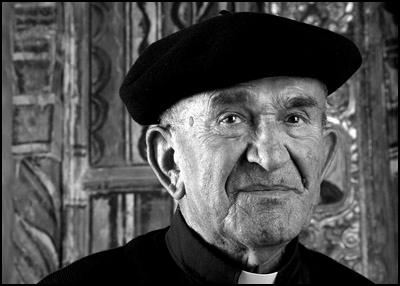
Father Casimiro Roca at 94.
That same year, 1929 a small, 11-year-old boy in Mura, Spain, asked his parents to let him enter the seminary. The family was poor butthe seminarians agreed to let him study with paying. The boy was Casimiro Roca. Times were hard.  His two brothers were killed during the Spanish civil war and Casimiro Roca fled to Italy where he completed his studies and took his vows in 1945.

"It was," he recalls, "the happiest day of my life to become a priest."

Meanwhile across the ocean in America, the Archdiocese of Santa Cruz in New Mexico was trying to figure out what to do with the rundown little chapel now in its charge — wellspring of so many legends and tales of healing, now fallen into disrepair.


But somewhere the wheels of divine providence were busy turning. Following a traumatic illness in 1950, Fr. Casimiro Roca decided to come to America to get a new start. In 1954, the archdiocese sent him to go to Chimayó to revive the little parish. There, he says, he fell in love with the people and the mountain. Several times he left but always come back. In 1984 he returned for keeps.

Courtyard conversation.
Over the more than 60 years that he has shepherded the small parish much has been done.

"We bought land. We planted trees. We buttressed the walls. We patched. We repaired," he recalls.

And he got a few breaks. In 1970 El Santuario del Chamiyó was designated a National Historic Landmark. Soon the trickle of pilgrims coming each year became a flood.  coming. Today,  more than a quarter million visitors come to Chamiyó each year &mash; as many as 30,000 during Holy Week alone. Some walk the 90 miles from Albuquerque.

Father Roca at 94 says he keeps busy but is slowing down. There is  pride mixed with annoyance as he recounts the years of hard work. "I did all this," he says with a sweeping gesture. "Now I am tired."

But the church, he says, will not let him retire. He talks about going back to Spain.


It is probably in the church's interest — as well as the chapel's — that he stays on. He has become a legend ass much as the sanctuary itself.

Wildflowers outside the  sanctuary at Chimayó, New Mexico.
He speaks castilian Spanish and comports himself with the dignity befitting a man of God.

He says he thinks his place was destined to be here and wonders how much longer the Church, or God, will keep him.

He has no regrets, he says. "None. And I thank God for that. I have my way of life here."


We say good-bye and head back to our bus in the chapel parking lot and pass wildflowers along the way. The short priest — all four feet, ten inches of him — seems as native to the soil as the desert flowers we see thriving around us.