Saturday, January 21, 2012

This Land Is Your Land, This Land Is My Land ....

We take off across country in mid-December, from Truth or Consequences, New Mexico, heading in hard cold to Santa Fe 225 miles to the north. Our goal—the Maitreya Project, opening in that city on the next night. The bus is cold, and there have been wiring harness problems; but now we roll along smoothly as darkness descends. We stop for gas just outside Santa Fe. A hard wind and 26 degrees.  We crash at a Red Roof motel—too cold to camp.

The Maitreya project has been touring the globe, a collection of more than 1,000 Buddhist relics, many of them pearl-like objects found among ashes of cremated Buddhist masters, believed to be relics of the masters themselves.

The exhibit began touring way back in March 2001. It crossed the United States this year. Santa Fe was the last stop in this country before re-opening in Guadalajara, Mexico, in January.

Buddhist nuns with shaven heads chant at the opening
of the Maitreya exhibit December 16th in Santa Fe, NM.

The exhibit in Santa Fe is held at a Catholic church where a large stain glass image of Jesus behind the altar set up to hold the relics around a statue of Buddha adds an ecumenical note to a serious yet joyful ceremony.

The Maitreya project will culminate in building a 500-foot tall stature of the Buddha in Kushnigar, India, where the relics will be housed.

The next morning it is not so cold. We grab a bagel and head southeast to re-join I-40 and then west to Santa Rosa. The bus purrs through hills flecked and dusted with snow. The sky is gray with occasional teasing patches of blue. Traffic is light.

In Santa Rosa we eat lunch at a downtown dinner. Santa Rosa is the town that time forgot, or rather that I-40 forgot when it by-passed it. Through the 1930, '40s and much of the '50s Santa Rosa lay in the sweet spot where legendary six-lane Route 66 cut through New Mexico,  the big east-west highway to the southwest. Now former stores, restaurants and motels stand empty. Santa Rosa is proper. The action such as it is has moved north, near the on-off I-40 ramps.

After a lunch of chicken fried steak we push on. The next 100 or so miles from Santa Rosa to Texas are flat. The sky is gray. The land all but deserted.

It's nightfall in Texas. Suddenly there are flashing blue lights in the rear view mirror. We get a warning ticket for a failed license plate light. The trooper is anything but polite, leaving us in a grim and angry mood.

We push on the Elk City, Oklahoma, and glad to be out of Texas. In Elk city we crash for the night but not before asking where to eat. We are directed to an all-you-can eat restaurant across the highway, where people apparently do just that—eat all they can. The avoir-du-pois of the clientele is mind-boggling. So too the next morning at Denny's. We wonder if this is what the middle of country is about—eating? Or this a legacy of I-40 truck stop cuisine?

Cotton clouds in a blue sky at dawn.
The next day, Sunday, the sky begins to clear. Blue sky and white spun candy clouds greet us as we hit the road. The weather is warms the bus is comfortable, the music plays through the radio. The spirit, if not the music itself, is Woody Guthrie—This Land Is Your Land, This Land Is My Land. It is immense, huge, this rolling country of ours we see rolling by out the windows as we roll east.

At gas stations and pit stops the people are cheerful. This is a land of big confidence and large SUVs, big sedans and humongous Ford pickups, Toyota Tundras.

We are a small bus among overloaded 18-wheelers, scary RV's and Harleys that pass us with buzzing insect sounding fury

In a few hours western Oklahoma gives way to the eastern part of the state, no longer flat but rolling hills and meandering rivers. Pastures are grassy and dotted by occasional stands of hardwoods—mostly oaks— not seen since we left New Mexico.

Low rain clouds brood ...
With each passing mile the landscape continues to look more eastern. It is as if we are witnessing the gradual unfolding of the plains in reverse.

By the time we reach Arkansas we are back in the east. Trees are the norm now, and there are small towns every 10 miles instead of every 50 or 100.

The towns are welcoming but the motels, the eateries, the gas stations,  the rest stops, the off-and-on ramps are identical. I-40 paints its way east with a dreary sameness of brush, smearing identical structures onto different canvases using limited imagination and no variation of palette. America the beautiful has become America the almost identical, with green and white highway signs, red, white and blue interstate markers, big and little box stores  in flat beige shopping malls illuminated by halogen lights and patrolled by security cars with flashing yellow lights.

They day fades to dusk and to dark. We stop at a motel outside Nashville. The bus seems as happy as we are to quite the highway after three days of travel. This motel like all the others has no charm. I'm beginning to miss the outdoor trees and grass and lukewarm showers of even the shabbiest park or campsite. But it is too cold and we are too much in a hurry
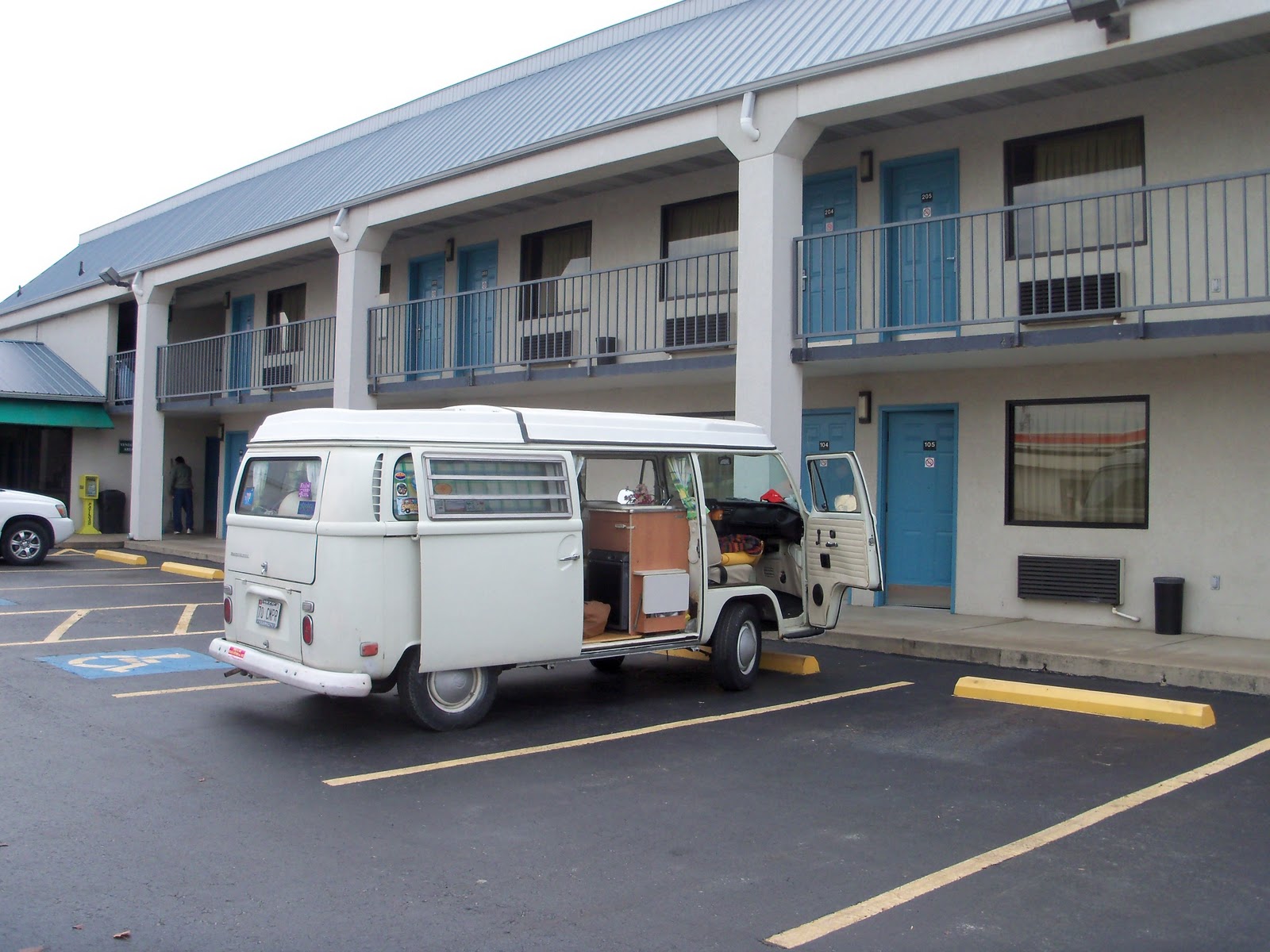
Motels begin to look the same.
The last stretch on the last day is a straight 425 shot from mid-Tennessee to mid-North Carolina.
Finally the road takes on some character. It bobs and weaves and climbs and falls as it snakes its way through the Smokies and the Blue Ridge mountains, following cascading rivers to the Piedmont.These aren't the mountains of the southwest, the Sangre de Cristos east of Santa Fe dancing with aspens and tall pines. These are the old folks of the east home to even older forests.

By the time we are into North Carolina four days of driving has taken its toll. It's is a straight shot through Hickory, Statesville, Winson-Salem and Greensboro where we hang a left toward Reidsville and home— a journey of 2,000 miles average 19.7 mpg at 56 miles per hour in a bus filled to the windows.
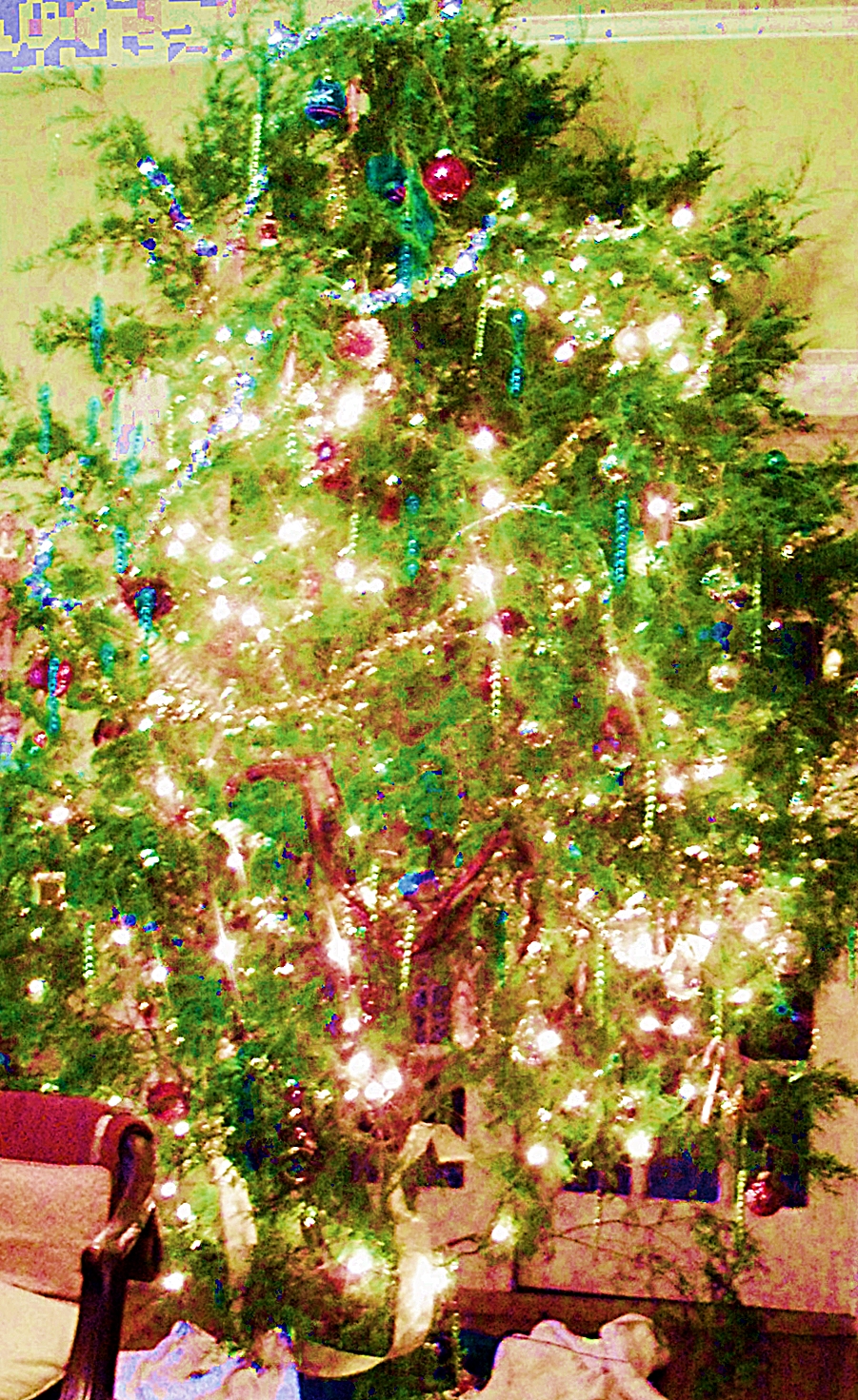
At 10:13 we are home, five days before Christmas. There will be many more bus adventures in store come spring.

Now it is time to unpack and regroup. There is the tree to get ready, and gratitude for another year.

Saturday, November 19, 2011

Beauty and Renewal


The beauty of life is in renewal.

As those who have followed this blog know it was set out and intended as a depiction of living and travels in a VW bus. Key to that adventure was Bus Companion. Fate cut her down last June.

The summer months were spent in healing, much of it in the town of Truth or Consequences, NM

Now that healing is well along. Life goes on. In 10 short days a new wonderful person will be flying out and joining me. We will renew travels in the bus, blogging about those travels, and eventually begin an eastward journey.

I have learned much in the months that have passed, about the beauty and the transitory nature of life and about the power of love. If life is a journey, as I believe it is, love is the fuel that powers that journey. Without it we are lost and fail to connect to the great world around us. It is only when we love that we are truly free.

This is my reason for being so long between posts—gearing up and  getting ready for the next stage and the next adventure in this brief thing called life.

Notes in passing.

A very fine gentleman, Walt Rogers (no relation) passed this way last weekend staying over in TorC for six days while on his way to the warmer clime of Quartzite, Arizona.

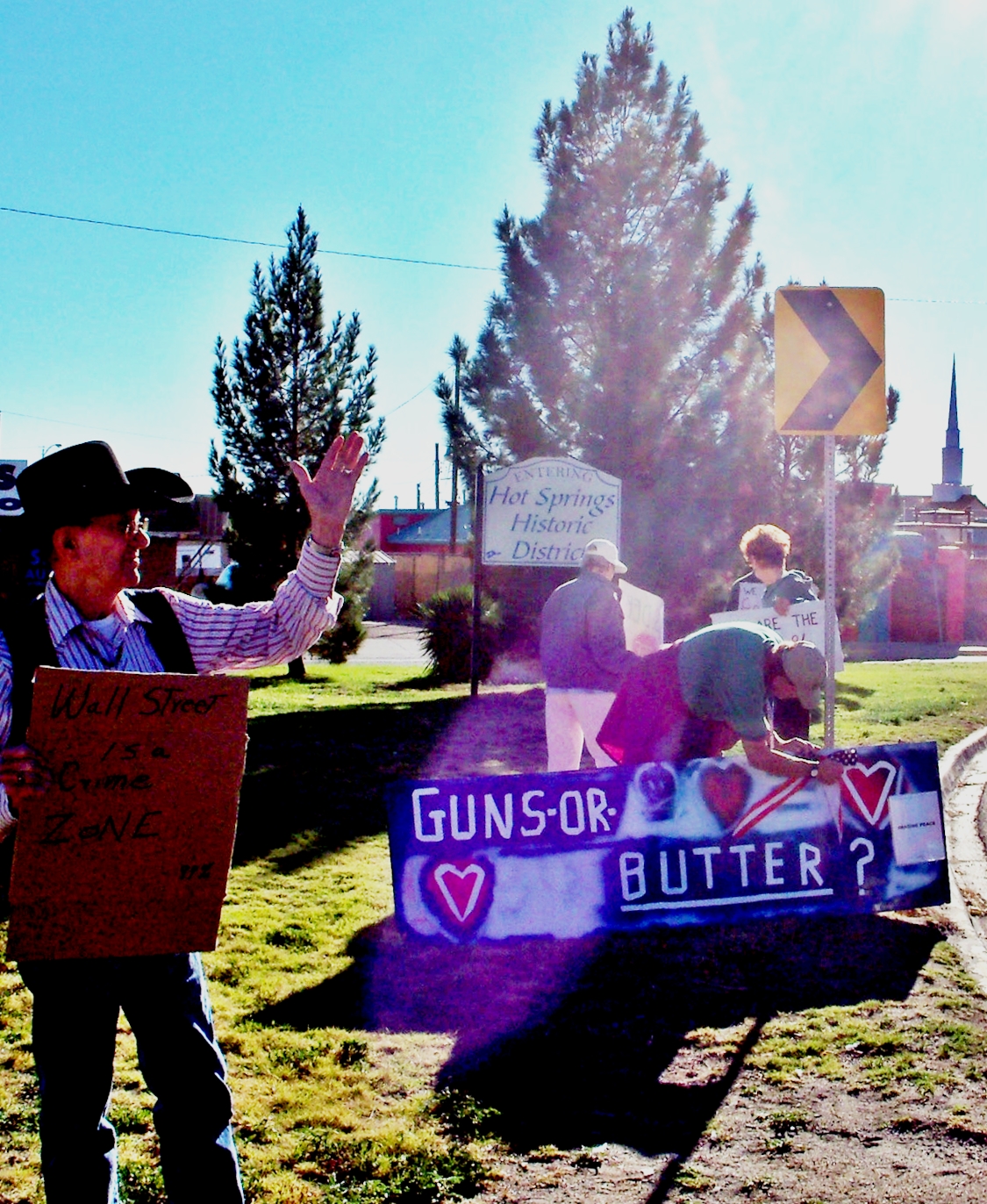
He took part in our weekly Thursday ritual here, Occupy TorC. Our ranks have grown from 17 the first week to more than 25 this past week.

It is a disparate and sometimes motley crew with homemade signs and big waves for the passing motorists who often as not wave back and honk their horns in show of support for something that they sense is an expression of something gone wrong in this great land that they know needs fixing.

Occupy TorC
What? I think that is the strength and the beauty of the OWS movement. It doesn't pretend to know or make demands but to raise questions and lift consciousness so that as more and more people get involved, more and more opinions are expressed little by little we will begin winnowing the wheat of clear thinking from the chaff of confusion.

Renewal is not only about life and love. It is about where we go as a people in this land and on this planet.

JNR

Thursday, November 3, 2011

Getting Caught in the TorC Vortex

The stories are legend. And none is the same. No one quite knows how it happens — maybe the car breaks down, or someone stops for the night. A friend calls, or they visit a spa, but somehow a person can set one foot in Truth or Consequences, and then the other. And then despite the best of intentions never leave. Or maybe they do leave but they seem always to come back.

It's called getting Sucked Into The TorC Vortex. Perhaps it's the mysterious the stone turtle on top of the mountain, perhaps it's that for thousands of years this has been a sacred and holy Indian meeting ground.  Or maybe it's the underwater hot water springs — 110 degrees of wetness just below the surface.

Or maybe it's because everybody here — well almost everybody — is just a little nuts.

Nobody knows why but people come and they stay and they can't get away even when they try.

We were sitting in the Black Cat Bookstore and Cafe just a week ago when Tess came in. Tess recently moved from Hawaii to Santa Fe and then from Santa Fe to here where she and her husband are building a health spa and retreat that will tap into the hot mineral water below.

"There is something really special about this place," she says while doing her morning yoga and gymnastics routines inside the bookstore. "Not like anyplace else. Even the moon looks different here."

Tess moved from Maui where she had a successful career in television, and in health and fitness. "I did all I could do there," she says, explaining that 40 she decided to come to the mainland.

When she speaks she still has that on look of awe and wonder about her for her new town and her dream of building a one-of-a-kind retreat.


Be careful Tess. You could be in danger of getting caught in the TorC Vortex from which there is no escape.

Tor C — Nothing To Do and All Day To Do It.

It is fall in New Mexico. It came quickly. One day it was 75 degrees, the next  50. The leaves are starting to turn and quickly blow away in stiff winds that sweep down from the mountains.

It is more established in the northern part of the state where the aspens yellow and quicken among dark pines. A friend from Santa Fe went up into the forests north of the city and sent back these remarkable images of fall in the northern part of the Land of Enchantment. Photos by Jude Byrne. Click to expand.


Click to expand.
Finally down south it was the season finale for this year's  Farmers' Market. The Turtleback Trio played. A chill wind blew off the Rio Grande. Few shoppers came and the vendors unloaded their goods at half price.

It's been a poor year for most vegetables, especially tomatoes. No one knows why. They grew late and small, some scarcely larger that golf balls. Same with apples and pears. Maybe the drought. And some pecan crops without irrgation failed entirely.

But the gourds and melons and pumpkins were fine — just in time for Hallowe'en.

Thursday, October 20, 2011

Music In The Air

I apologize  that there are no photos in this post. I did not have a camera with me this morning. I may go back later and get some art, but I wanted to post this while all was  fresh.


I walk down Broadway and the morning sun is bright, the air crisp and cool. Broadway is the main drag through Truth or Consequences. I pass by the Red Bone, a store that has been closed for months, and I hear music—the cheerful wail of an early morning trumpet. I know the source.

Though the Red Bone has been closed, the store is not empty. Inside, several folks who need places to live have set up housekeeping, with the owner's permission, dividing the back of the store into sleeping areas and fashioning a kitchen. The front of the store, visible from the outside, looks like furniture store with chairs and tables and couches.

One of those staying there is Garland, former trumpeter in the Marine Corps Band and horn man for many groups in the 1960s, '70s and '80s when brass was big in rock.  He is older and grayer now with a huge  mane of hair and a white Santa Claus beard that makes him look like what an aging Jerry Garcia might have looked like had he lived as long. I don't have to go around to the back to go in to know the sound spilling out under the door and onto the sidewalk is coming from a man sitting in a chair, eyes closes, fingering the worn brass valve stops, lost in thought and  music. I go on

Ten minutes later I am walking back down Broadway on the opposite side of the street. Again I hear music. But this time it is coming from an open door a few yards in front of me. I approach and peek inside. I see Ruth, the owner/artist doing a dance around the bright Jackson Pollack style paintings she is working on spread out on the cement floor. Paint and high spirits are splattered everywhere, including a pooling puddle of school bus orange beside a half done canvas.

And  Ruth, in the middle of it all, dancing, eyes bright, looking at her paintings. The music finishes just as I enter. She stops with a grin and a bow, beaming.

I hadn't been in her gallery in a week or so but I notice a change. The price tags she had been putting up beside her works on the walls have all been taken down. I mention it.

"You know, I had to. Once I start thinking in dollars and cents something goes out of me. I have to paint for pure joy and expression."

We hug. There isn't much more to say.

There is music in the air.

Thursday, October 13, 2011

The Open Road and the Open Sea — Junkyard Art

It's warm again, and the evening sun is bathing Truth or Consequences in a peaceful glow. I picked up my bus from Tunie, the mechanic, on Tuesday. It seems to be running fine. Now it, too, is sitting bathed in evening sun with a faraway look in its headlights that seems to say—Hey, I'm all well again. Can we go someplace? I nod in agreement.

Meanwhile I'm waiting to hear from SwankieWheels, who may be passing through TorC on her way to Arizona in the next day or so. Or maybe not. It is after all the migratory season.

Since mankind began farming and we tied ourselves to the soil, we've given up for the most part our migratory ways. But there was a time—and it's rooted deep in our souls—and maybe that's why it feels so right especially at this time of year to take our few possession and set off to go somewhere. The stars are out, the moon is high. Let's go 100, no make that 200 miles. Tires hum, wind blows. And for a tire-humming, wind-blowing moment we  are immortal. Maybe we are. The road rolls out behind us like a past life and stretches forward toward a new existence.

Tunie's art. Click to enlarge.
The  old cars in front of Tunie's shop to me are works of art. They tell stories.They lie in a peaceful state of decomposition having have escaped the crusher—the auto world equivalent of cremation. It is better to let things go their natural way including our automobiles and our flesh. There is something unnatural about the high temperatures at which we sear our bodies to ash and the high pressures we use to crush our cars to tiny blocks of metal.

The is a kinship between ourselves and our vehicles unlike any we have with other objects. We remember them all, just as we remember our loves. And like a lover our cars take us to places that we can never go to alone.

So now I'm talking to my bus. Putting things away in her. She says we've been in town too long. We're a little like sailors, those of us who travel and live on the road. A port of call looks inviting, and we tell ourselves we will stay for a while. But after a while it gets strangely confining and even lonely. There is a camaraderie on the road not found elsewhere. And there is closeness and connection in the parks and mountains, seashores and starry skies.

Home is the open road, the open sea.


Monday, October 10, 2011

Fear and Hope in Heartland America

Still no word on my bus, on my home on wheels. I'm to call Tunie, my mechanic, tomorrow. It will be three weeks. Now I remember why I always did the work myself.

Meanwhile, news from the heartland.

We were sitting around the table at the Black Cat book store here in Truth or Consequences Friday morning when the topic turned to Survivalism.  There were about eight of us.

"Sue, what are you doing to survive?" one of the company was asked as she sat down. This was not about earning one's daily bread. No. More like about stashing away 50 pounds of dried beans and having enough water purification tablets to last when we have to start going down to the river for water. In short, the breakdown of civilization as we know it.

Not everyone was sure the end was near. At the other end of the spectrum there was upbeat enthusiasm. "I'm not worried," someone said. "Whatever I need will always just appear. It always does."
The beautiful post office building built in 1939
during another period of not-so-good times.

There seem to be two currents of thought running through America these days—that the world is coming to an end—or that the world is coming to a new beginning.

Those who see hard times ahead see a breakdown of the electric grid, the transportation networks, outbreaks of famine and disease, riots and social upheavals in the cities, and so on.

Those who see the world changing for the better believe the seeds are already in the ground for a new crop of consciousness to rise up. Cooperation and harmony will flourish, we will live better with less, environmental damage will cease and the planet will begin to heal, the corporate state will wither away, mankind be reborn in a spiritual awakening —all somehow linked to realignment of the planets and stars on or around December 21, 2012, at the end of the 13th and beginning of the 14th baktun of the Mayan calendar.

The two seemingly opposed views flourished in discussion and began to gain common ground.

"Maybe we are talking about the same thing," said one gentleman. "The breakdown of the old order which gives rise to fear is necessary for the birth of the new which gives rise to hope."

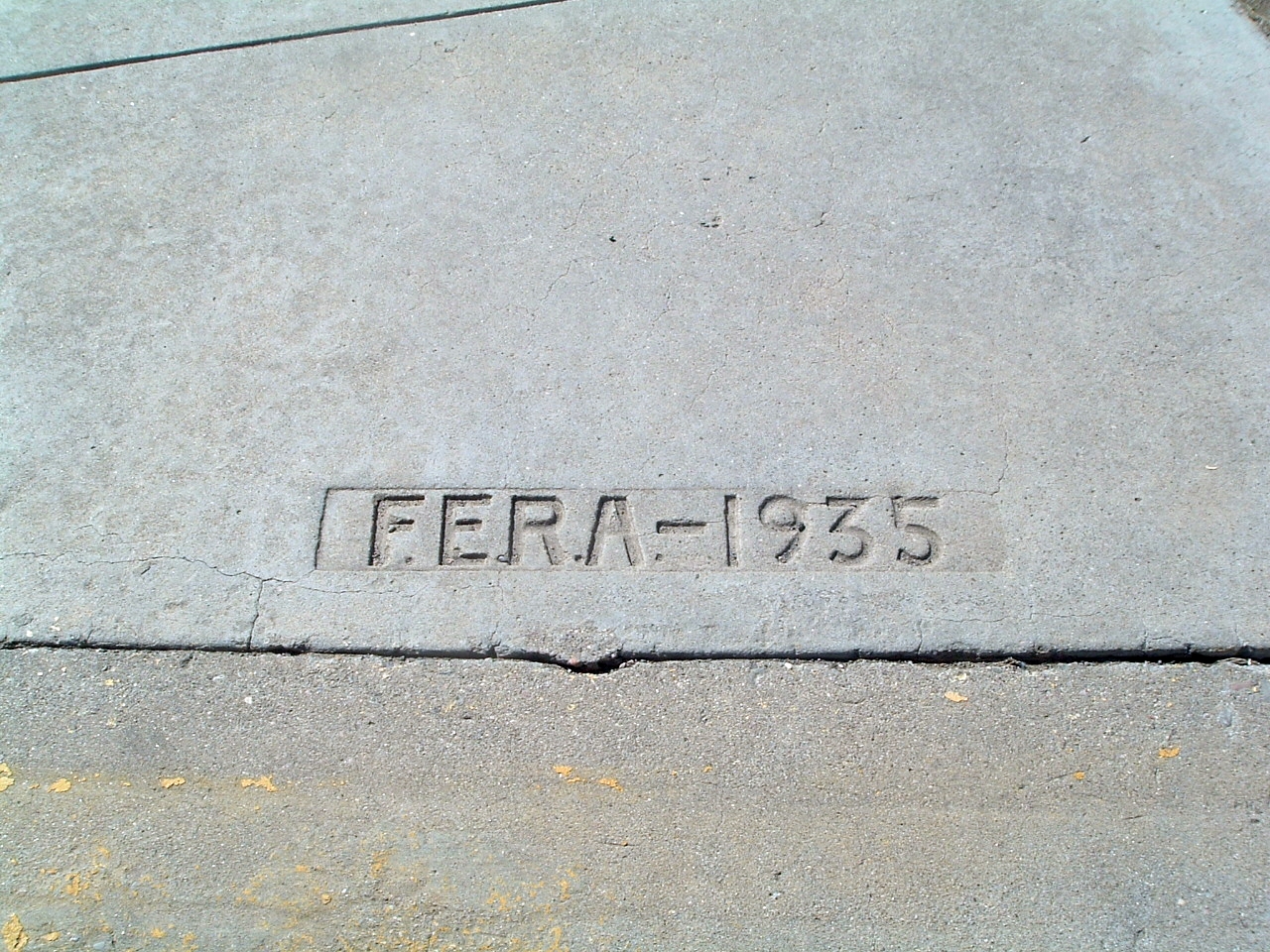
Sidewalk markers from ....
....  earlier times in TorC.
What about what's going in now? The Occupation of Wall Street? asked another.

"Their hearts are in the right place but it won't be by changing institutions that we get there from here," said a man in a baseball cap. "The change, as Gandhi said, has to come from within.  You have to become the change you wish to see."

By now the coffee was getting cold,  the scones had been eaten, and the cafe owner was not selling a lot of books.

Outside the sun was shining on sidewalks laid down in a different era of hard times, the Depression, by the Federal Emergency Relief Administration (FERA) and later the Works Progress Administration (WPA). The sidewalks are still around more than 70 years later.

"The main thing," a woman  said as we exited the door into the bright daylight, "is that life goes on. It always does and always will."

Tuesday, October 4, 2011

Turtleback Mountain

Folks who live in Truth or Consequences refer to the mountain across the Rio Grande as Turtleback Mountain. There is a song about TorC that begins, "(u)nder the shadow of Turtleback Mountain ... "

But it is not always clear why the big slab of rock across the way bears the name until the setting sun hits at just the right angle, creating lights and shadows showing a giant tortuga splayed upon the summit.


Turtleback Mountain by day
Turtleback Mountain in evening sun.