Saturday, November 19, 2011

Beauty and Renewal


The beauty of life is in renewal.

As those who have followed this blog know it was set out and intended as a depiction of living and travels in a VW bus. Key to that adventure was Bus Companion. Fate cut her down last June.

The summer months were spent in healing, much of it in the town of Truth or Consequences, NM

Now that healing is well along. Life goes on. In 10 short days a new wonderful person will be flying out and joining me. We will renew travels in the bus, blogging about those travels, and eventually begin an eastward journey.

I have learned much in the months that have passed, about the beauty and the transitory nature of life and about the power of love. If life is a journey, as I believe it is, love is the fuel that powers that journey. Without it we are lost and fail to connect to the great world around us. It is only when we love that we are truly free.

This is my reason for being so long between posts—gearing up and  getting ready for the next stage and the next adventure in this brief thing called life.

Notes in passing.

A very fine gentleman, Walt Rogers (no relation) passed this way last weekend staying over in TorC for six days while on his way to the warmer clime of Quartzite, Arizona.

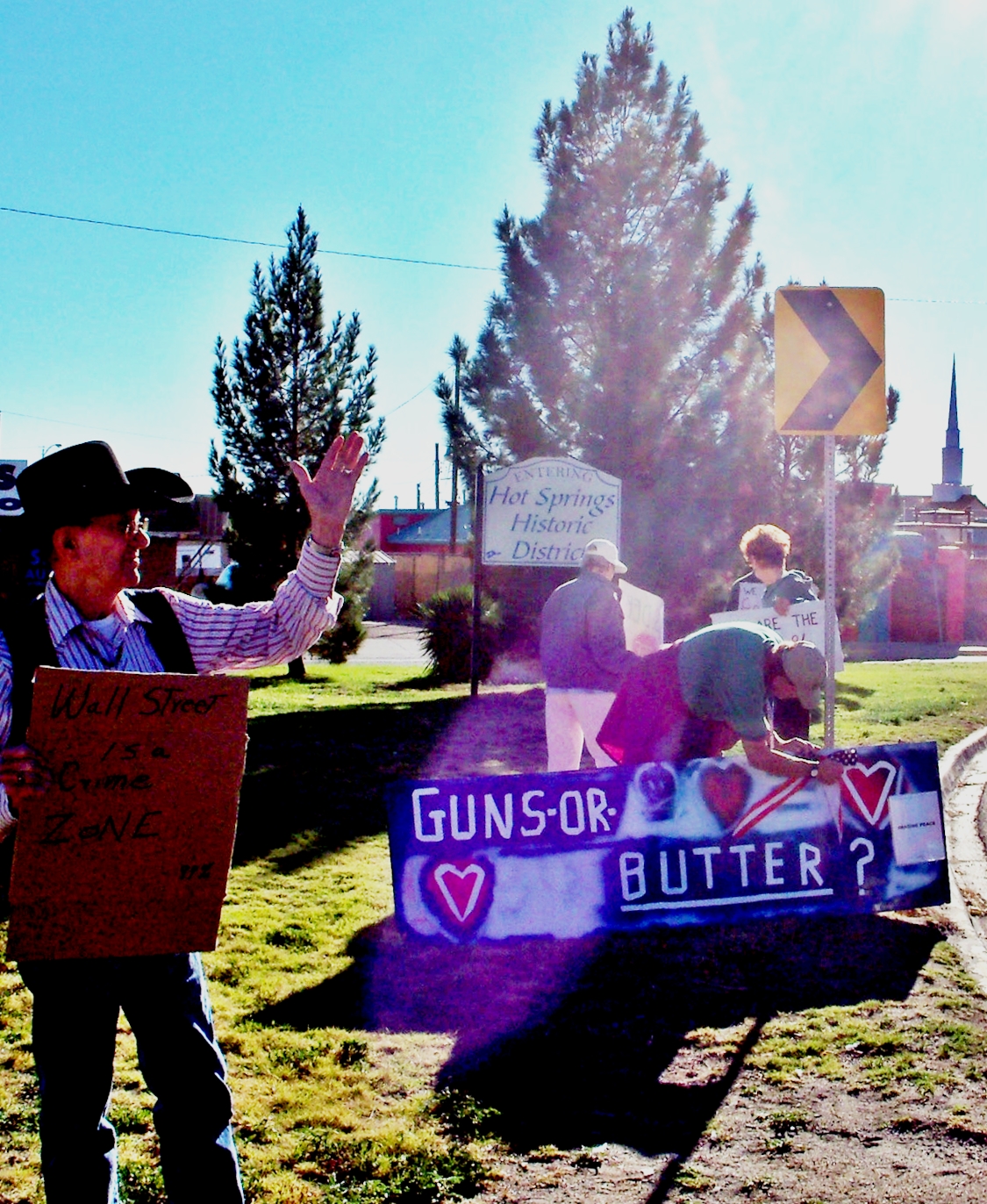
He took part in our weekly Thursday ritual here, Occupy TorC. Our ranks have grown from 17 the first week to more than 25 this past week.

It is a disparate and sometimes motley crew with homemade signs and big waves for the passing motorists who often as not wave back and honk their horns in show of support for something that they sense is an expression of something gone wrong in this great land that they know needs fixing.

Occupy TorC
What? I think that is the strength and the beauty of the OWS movement. It doesn't pretend to know or make demands but to raise questions and lift consciousness so that as more and more people get involved, more and more opinions are expressed little by little we will begin winnowing the wheat of clear thinking from the chaff of confusion.

Renewal is not only about life and love. It is about where we go as a people in this land and on this planet.

JNR

Thursday, November 3, 2011

Getting Caught in the TorC Vortex

The stories are legend. And none is the same. No one quite knows how it happens — maybe the car breaks down, or someone stops for the night. A friend calls, or they visit a spa, but somehow a person can set one foot in Truth or Consequences, and then the other. And then despite the best of intentions never leave. Or maybe they do leave but they seem always to come back.

It's called getting Sucked Into The TorC Vortex. Perhaps it's the mysterious the stone turtle on top of the mountain, perhaps it's that for thousands of years this has been a sacred and holy Indian meeting ground.  Or maybe it's the underwater hot water springs — 110 degrees of wetness just below the surface.

Or maybe it's because everybody here — well almost everybody — is just a little nuts.

Nobody knows why but people come and they stay and they can't get away even when they try.

We were sitting in the Black Cat Bookstore and Cafe just a week ago when Tess came in. Tess recently moved from Hawaii to Santa Fe and then from Santa Fe to here where she and her husband are building a health spa and retreat that will tap into the hot mineral water below.

"There is something really special about this place," she says while doing her morning yoga and gymnastics routines inside the bookstore. "Not like anyplace else. Even the moon looks different here."

Tess moved from Maui where she had a successful career in television, and in health and fitness. "I did all I could do there," she says, explaining that 40 she decided to come to the mainland.

When she speaks she still has that on look of awe and wonder about her for her new town and her dream of building a one-of-a-kind retreat.


Be careful Tess. You could be in danger of getting caught in the TorC Vortex from which there is no escape.

Tor C — Nothing To Do and All Day To Do It.

It is fall in New Mexico. It came quickly. One day it was 75 degrees, the next  50. The leaves are starting to turn and quickly blow away in stiff winds that sweep down from the mountains.

It is more established in the northern part of the state where the aspens yellow and quicken among dark pines. A friend from Santa Fe went up into the forests north of the city and sent back these remarkable images of fall in the northern part of the Land of Enchantment. Photos by Jude Byrne. Click to expand.


Click to expand.
Finally down south it was the season finale for this year's  Farmers' Market. The Turtleback Trio played. A chill wind blew off the Rio Grande. Few shoppers came and the vendors unloaded their goods at half price.

It's been a poor year for most vegetables, especially tomatoes. No one knows why. They grew late and small, some scarcely larger that golf balls. Same with apples and pears. Maybe the drought. And some pecan crops without irrgation failed entirely.

But the gourds and melons and pumpkins were fine — just in time for Hallowe'en.

Thursday, October 20, 2011

Music In The Air

I apologize  that there are no photos in this post. I did not have a camera with me this morning. I may go back later and get some art, but I wanted to post this while all was  fresh.


I walk down Broadway and the morning sun is bright, the air crisp and cool. Broadway is the main drag through Truth or Consequences. I pass by the Red Bone, a store that has been closed for months, and I hear music—the cheerful wail of an early morning trumpet. I know the source.

Though the Red Bone has been closed, the store is not empty. Inside, several folks who need places to live have set up housekeeping, with the owner's permission, dividing the back of the store into sleeping areas and fashioning a kitchen. The front of the store, visible from the outside, looks like furniture store with chairs and tables and couches.

One of those staying there is Garland, former trumpeter in the Marine Corps Band and horn man for many groups in the 1960s, '70s and '80s when brass was big in rock.  He is older and grayer now with a huge  mane of hair and a white Santa Claus beard that makes him look like what an aging Jerry Garcia might have looked like had he lived as long. I don't have to go around to the back to go in to know the sound spilling out under the door and onto the sidewalk is coming from a man sitting in a chair, eyes closes, fingering the worn brass valve stops, lost in thought and  music. I go on

Ten minutes later I am walking back down Broadway on the opposite side of the street. Again I hear music. But this time it is coming from an open door a few yards in front of me. I approach and peek inside. I see Ruth, the owner/artist doing a dance around the bright Jackson Pollack style paintings she is working on spread out on the cement floor. Paint and high spirits are splattered everywhere, including a pooling puddle of school bus orange beside a half done canvas.

And  Ruth, in the middle of it all, dancing, eyes bright, looking at her paintings. The music finishes just as I enter. She stops with a grin and a bow, beaming.

I hadn't been in her gallery in a week or so but I notice a change. The price tags she had been putting up beside her works on the walls have all been taken down. I mention it.

"You know, I had to. Once I start thinking in dollars and cents something goes out of me. I have to paint for pure joy and expression."

We hug. There isn't much more to say.

There is music in the air.

Thursday, October 13, 2011

The Open Road and the Open Sea — Junkyard Art

It's warm again, and the evening sun is bathing Truth or Consequences in a peaceful glow. I picked up my bus from Tunie, the mechanic, on Tuesday. It seems to be running fine. Now it, too, is sitting bathed in evening sun with a faraway look in its headlights that seems to say—Hey, I'm all well again. Can we go someplace? I nod in agreement.

Meanwhile I'm waiting to hear from SwankieWheels, who may be passing through TorC on her way to Arizona in the next day or so. Or maybe not. It is after all the migratory season.

Since mankind began farming and we tied ourselves to the soil, we've given up for the most part our migratory ways. But there was a time—and it's rooted deep in our souls—and maybe that's why it feels so right especially at this time of year to take our few possession and set off to go somewhere. The stars are out, the moon is high. Let's go 100, no make that 200 miles. Tires hum, wind blows. And for a tire-humming, wind-blowing moment we  are immortal. Maybe we are. The road rolls out behind us like a past life and stretches forward toward a new existence.

Tunie's art. Click to enlarge.
The  old cars in front of Tunie's shop to me are works of art. They tell stories.They lie in a peaceful state of decomposition having have escaped the crusher—the auto world equivalent of cremation. It is better to let things go their natural way including our automobiles and our flesh. There is something unnatural about the high temperatures at which we sear our bodies to ash and the high pressures we use to crush our cars to tiny blocks of metal.

The is a kinship between ourselves and our vehicles unlike any we have with other objects. We remember them all, just as we remember our loves. And like a lover our cars take us to places that we can never go to alone.

So now I'm talking to my bus. Putting things away in her. She says we've been in town too long. We're a little like sailors, those of us who travel and live on the road. A port of call looks inviting, and we tell ourselves we will stay for a while. But after a while it gets strangely confining and even lonely. There is a camaraderie on the road not found elsewhere. And there is closeness and connection in the parks and mountains, seashores and starry skies.

Home is the open road, the open sea.


Monday, October 10, 2011

Fear and Hope in Heartland America

Still no word on my bus, on my home on wheels. I'm to call Tunie, my mechanic, tomorrow. It will be three weeks. Now I remember why I always did the work myself.

Meanwhile, news from the heartland.

We were sitting around the table at the Black Cat book store here in Truth or Consequences Friday morning when the topic turned to Survivalism.  There were about eight of us.

"Sue, what are you doing to survive?" one of the company was asked as she sat down. This was not about earning one's daily bread. No. More like about stashing away 50 pounds of dried beans and having enough water purification tablets to last when we have to start going down to the river for water. In short, the breakdown of civilization as we know it.

Not everyone was sure the end was near. At the other end of the spectrum there was upbeat enthusiasm. "I'm not worried," someone said. "Whatever I need will always just appear. It always does."
The beautiful post office building built in 1939
during another period of not-so-good times.

There seem to be two currents of thought running through America these days—that the world is coming to an end—or that the world is coming to a new beginning.

Those who see hard times ahead see a breakdown of the electric grid, the transportation networks, outbreaks of famine and disease, riots and social upheavals in the cities, and so on.

Those who see the world changing for the better believe the seeds are already in the ground for a new crop of consciousness to rise up. Cooperation and harmony will flourish, we will live better with less, environmental damage will cease and the planet will begin to heal, the corporate state will wither away, mankind be reborn in a spiritual awakening —all somehow linked to realignment of the planets and stars on or around December 21, 2012, at the end of the 13th and beginning of the 14th baktun of the Mayan calendar.

The two seemingly opposed views flourished in discussion and began to gain common ground.

"Maybe we are talking about the same thing," said one gentleman. "The breakdown of the old order which gives rise to fear is necessary for the birth of the new which gives rise to hope."

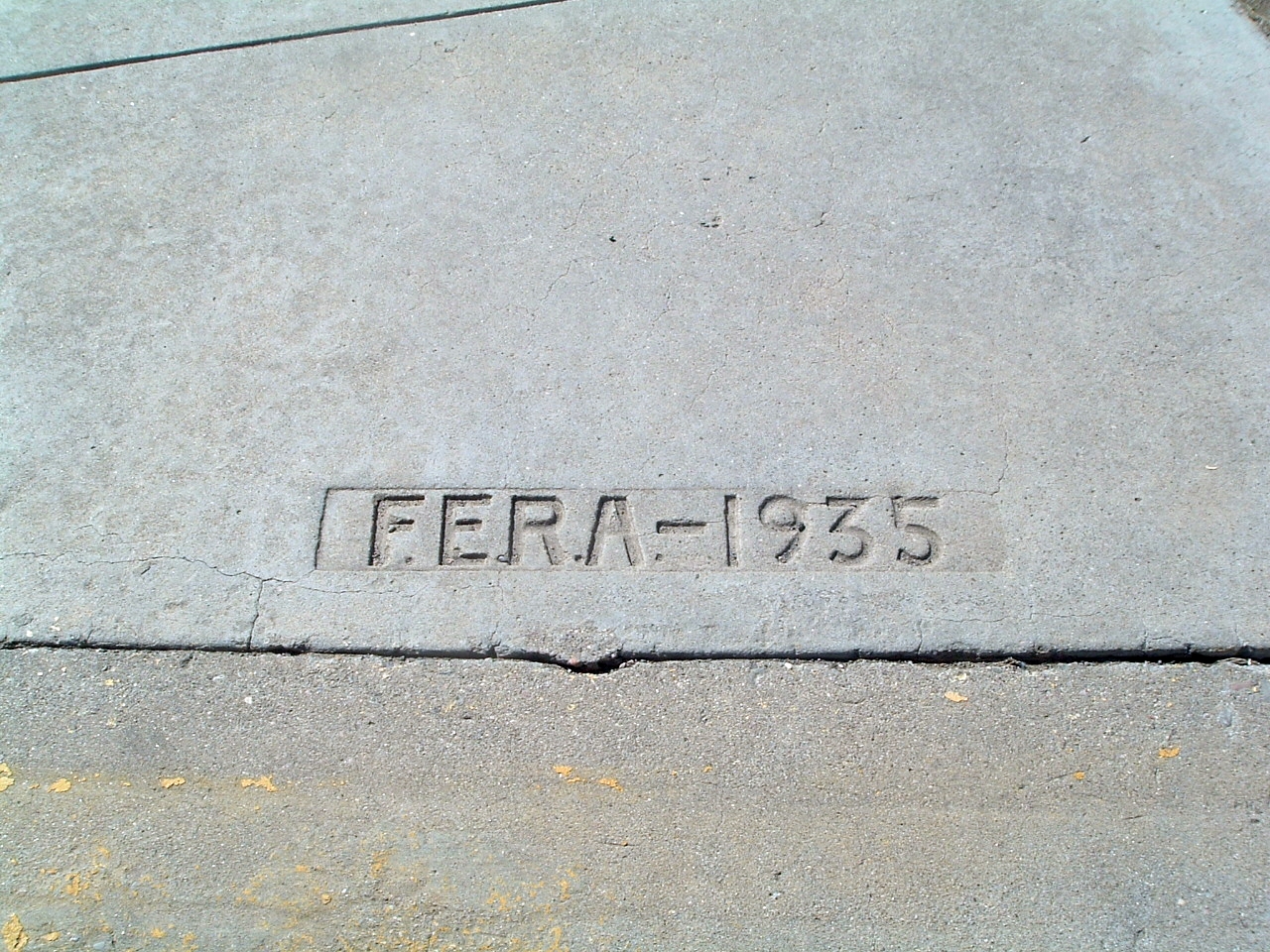
Sidewalk markers from ....
....  earlier times in TorC.
What about what's going in now? The Occupation of Wall Street? asked another.

"Their hearts are in the right place but it won't be by changing institutions that we get there from here," said a man in a baseball cap. "The change, as Gandhi said, has to come from within.  You have to become the change you wish to see."

By now the coffee was getting cold,  the scones had been eaten, and the cafe owner was not selling a lot of books.

Outside the sun was shining on sidewalks laid down in a different era of hard times, the Depression, by the Federal Emergency Relief Administration (FERA) and later the Works Progress Administration (WPA). The sidewalks are still around more than 70 years later.

"The main thing," a woman  said as we exited the door into the bright daylight, "is that life goes on. It always does and always will."

Tuesday, October 4, 2011

Turtleback Mountain

Folks who live in Truth or Consequences refer to the mountain across the Rio Grande as Turtleback Mountain. There is a song about TorC that begins, "(u)nder the shadow of Turtleback Mountain ... "

But it is not always clear why the big slab of rock across the way bears the name until the setting sun hits at just the right angle, creating lights and shadows showing a giant tortuga splayed upon the summit.


Turtleback Mountain by day
Turtleback Mountain in evening sun.

Saturday, September 24, 2011

Three Men and Their Trades

An 8-foot stack of sun-bleached
bones outside Charlie's antler emporium.
.
I heard him before I saw him, muttering softly to himself or perhaps singing. There was no moon but enough ambient light to make out the figure of a man wearing a hat and a beard and carrying and tall and loaded backpack frame. He passed by me and walked about 50 yards, then turned around and came back. I was curious who this person was and so I waited. Obligingly on his approach he introduced himself as Freddie and set down his heavily loaded backpack frame.

He also set down a large blue and white checked cloth neatly folded and tied at the corners which he untied to display the contents: a small bundle of dry mesquite wood, some rice, beans, onions and chunks of meat.

"All I need is a pot to cook 'em in," he said.

"Where are you from?" I asked. "And did you walk?"

"Redding. Redding, California. Walked most of the way," he said. "Hitched a few trains too."

The odd thing about Freddie was that he was neat and clean. Not at all the stereotypical hobo. His hair was cut, his beard trimmed. He looked about 45. His backpack frame and its contents all clean if not spanking new. No smell of sweat, drink or cigarettes.

"What are you doing?" I asked. "Camping by the river." he replied.  He surveyed his stash of food and wood lying on the ground. "Just need a pot to cook in," he repeated. "I'll bring it back," he said imploringly. "I'll find some wire and ball it up and scrub it clean."

It was, I decided, worth the gamble. I brought out my old Coleman cooking pot and lid and offered it to him. He accepted. "I'll bring it back," he promised.

"What are the odds he'll bring it back?" I asked my friend standing next to me. "About one in three against," she said.

I watched him disappear into the night. It was the last time I saw my pot.

The trouble with being on the road and owning and living in a VW bus is that no one works on them any more. Well, hardly anyone. In Las Cruces, NM, there is Tunie. He was recommended by a garage in Truth or Consequences as about the only one left within a hundred miles who works on aircooleds.

I'd beat the bus up pretty bad in the summer, driving it hard in hundred degree temps on mountain roads. I figured new heads at least for openers, but never got around to starting the project, and now fall is coming and I need something reliable and was willing to pay if only I could find someone to do it.

It was about 70 miles straight down from TorC to exit 9 on I-25 and then a three or four mile jag down some back roads Tuesday to get to Tunie's, a soft-spoken man well into his  years, from Mexico, with some 42 years of VW wrench turning under his belt. His house, he said, was the pink one at 145 San Ysidora Road.

I didn't need a mailbox or house color to find it. Tunie's was the dwelling with a dozen dead and dying VWs in various stages of decay in the front. I had made an appointment. Tunie was expecting me.

He ambled out, a big man, walking slow. His eyes twinkled. "Nice bus," he said. I thanked him.

He nodded. After some talk I left things in his care. Three days, he said, to  pull the engine, rebuild the top end, test it, tune it and get it back to me.  That was Tuesday.

Thursday came and Tunie called. He had an eye infection and couldn't work, a patch on one eye. I took him at his word. On Saturday I dropped by.  There was my engine now disassembled, and Tunie, eye-patch removed, going over each part and examining it with loving care. We fell into talking VW. "Take your time," I told him, my faith in the soft-spoken man growing.  "Whatever it needs do it. I want to be able to drive to the Pacific Northwest this fall. And across country." His eyes twinkled. 'When I am finished you will be able to drive anywhere without  worry for years."

That's what I wanted to hear. Keep wrenching, Tunie. You are part of a dying breed.

I met Charlie an hour our so outside of Yellowstone National Park  in Montana on the way to Cody. It wasn't hard to meet Charlie. An eight-foot stack of sun-bleached skulls and antlers in front of his barn/workshop announces his presence just off the highway.

Charlie in his youth had been a roustabout in the oil fields of Montana until the fields shut down. With  a home and family to support, he looked for a way to make a living, selling arrowheads and souvenirs to tourists heading to and coming from nearby Yellowstone. It was slim pickings at first. So Charlie enlarged the menu, adding furs, knick-knacks, stuffed animals, mounted heads.

But the breakthrough came when Charlies discovered some folks just like antlers. And there were plenty of them around for the taking. Elk and moose and deer shed their antlers annually. Soon Charlie had more antlers than he could use. What to do with them all?

Charlie's antler chandelier. 
It was then that he got creative. He decided to use elk and moose and deer antlers the way other craftsmen might use driftwood—to fashion displays, make artifacts, using the natural curves and curls of his materials to create designs. And business began to take off.

"I guess I created this industry," he says. "It's kind of a recycling these things one last go."

Growing antlers each year is a nutritional drain on large cervids such as elk, moose and deer. They grow rapidly and require lots of food intake.

Charlie rubs his chin philosophically. "It's a shame to see all that natural effort go to waste."

Out in front the stack of bleached bones, skulls and antlers testifies to nature's bounty. "And they can be pretty and useful too."

About Antlers—Antlers serve many functions, from fighting to adornment. Reindeer in the north use antlers to clear ice and snow when foraging for food. But perhaps none is more unusual than that of the moose. Studies show a moose without a rack does not hear as well as its horned brethren. The antlers serve the moose, among other things, scientists believe, as a giant parabolic sound reflector.

JNR